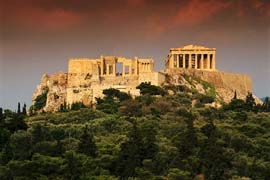
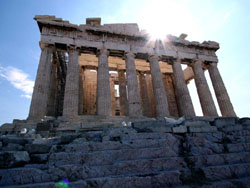
THE ACROPOLIS: For thousands of years the Acropolis has been the symbol of Athens, the sacred rock, the link that connects the magnificent ancient civilization with the modern. The Acropolis and its monuments, its history and the myths that are connected with it are rightly the pride and the glory of this city, the envy of all other cities in the world. There is no Greek or foreign visitor who does not want to make the pilgrimage to the sacred rock and absorb its magnificence and beauty. If you have never been to the Acropolis I assure you it is a unique and unforgettable experience. On the hill of the Acropolis you will see the masterpieces of: Parthenon, Propylea, Temple of Athena Nike, Erechtheion & The Cariatides, Ariopagus (Mars Hill), Herodion Theater and the Theater of Dionysus.
OPEN (Nov 1 - March 31, 2012): 8:30-15:00
OPEN (April 1 - October 31, 2012): 8:00-19:00 (Weekends and Holiday's open 8:00 - 15:00
ENTRANCE FEE Full: €12, Reduced: €6. VALID: Acropolis, Ancient Greek Agora, Museum of Kerameikos, Kerameikos (The ancient Cemetery of Athens), Museum of the Ancient Agora (Stoa of Attalos), North slope of Acropolis, Olympieio(Temple of Zeus), Roman Agora of Athens, South Slope of Acropolis.
THE AREOPAGUS (Mars hill): Is the most ancient court of law and the most respected place in ancient times. It is the 'Rock of Ares', north-west of the Acropolis. Here was the seat of the first aristocratic parliament of Ancient Athens. In time this parliament started to lose its political power and from the second half of the 5th century B.C. it had only judicial responsibility and particularly that of trying murderers. Ares was supposed to have been tried here by gods for the murder of Poseidon's son Alirrothios. In Eumenides of Aeschylus, the Areopagus is the site of the trial of Orestes for killing his mother, Clytemnestra, and her lover, Aegisthos. The origin of its name is not clear. In Greek pagos means big piece of rock. Areios could have come from Ares or from the Erinyes, as on its foot was erected a temple dedicated to the Erinyes where murderers used to find shelter so as not to face the consequences of their actions. Later, the Romans referred to the rocky hill as "Mars Hill," after Mars, the Roman God of War. Near the Areopagus was also constructed the basilica of Dionysius Areopagites. It was from this spot, as we learn from the bronze tablet at the base of the rock, that Saint Paul delivered his first sermon to the Athenians, in AD 51: 'Now what you worship as something unknown I am going to proclaim to you. The God who made the world and everything in it is the Lord of heaven and earth and does not live in temples built by hands.'
THE TEMPLE OF OLYMPIAN ZEUS: (Olympieion): is a colossal ruined temple in the centre of Athens that was dedicated to Zeus, king of the Olympian gods. Construction began in the 6th century BC during the rule of the Athenian tyrants, who envisaged building the greatest temple in the ancient world, but it was not completed until the reign of the Roman Emperor Hadrian in the 2nd century AD some 650 years after the project had begun. During the Roman periods it was renowned as the largest temple in Greece and housed one of the largest cult statues in the ancient world..
THE PANATHENAIC STADIUM:(Kallimarmaro): is the only major stadium in the world built entirely of white marble (from Mount Penteli). And, it is the original stadium built in the 1800s for the first modern Olympic games in 1896. .
THE HILL OF LYCABETUS: Lycabettus is the highest hill of Athens, which overlooks the capital from 277 meters( 908 feet). It is considered as one of the most romantic places while it certainly stands out for its panoramic view of the beautiful city. You have a 360 view of the city and you can see from Acropolis to Piraeus and the Saronic Gulf. Pine trees cover its base, and at its peak are the 19th century church of Saint George, a theater and a restaurant. Lycabettus appears in various legends. Popular stories suggest it was once the refuge of wolves, possibly the origin of it's name (which means " (the hill of the wolves"). Myth logically, Lycabettus hill was credited by Athena, when she dropped a mountain she had been carrying for for the construction of the Acropolis. On the hill of Lycabuttus there is also a large open-air theater, which has housed many Greek and international concerts.
.
THE HILL OF FILOPAPOU:[Filopappu, 114-116 AD] has been erected as a monument to Gaius Julius Antiochus Philopappus, a benefactor of Athens. It is located on a hill opposite to the Acropolis with a splendid view over the entire basin of Attica .
THE NEW ACROPOLIS MUSEUM: is located in Athens historic area of Makriyianni. It stands less than a 300m away from the Parthenon which can be viewed from the glass gallery. It opened on June 20th, 2009 after 30 years of planning. It is designed in a way that allows visitors to see all the exhibits in natural light and incorporates a number of on-site excavations including a large urban settlement dated from the Archaic to Early Christian Athens.
Mon: closed, Tues-Sun: 8:00-20:00
ENTRANCE FEE: €5
THE NATIONAL ARCHAEOLOGICAL MUSEUM: is the largest museum in Greece and one of the world's greatest museums. Although its original purpose was to secure all the finds from the nineteenth century excavations in and around Athens, it gradually became the central National Archaeological Museum and was enriched with finds from all over Greece. Its abundant collections, with more than 20,000 exhibits, provide a panorama of Greek civilization from the beginnings of Prehistory to Late Antiquity.
The museum is housed in an imposing neoclassical building of the end of the nineteenth century, which was designed by L. Lange and remodelled by Ernst Ziller. The vast exhibition space - numerous galleries on each floor accounting for a total of 8,000 square metres - house five large permanent collections: The Prehistoric Collection, which includes works of the great civilizations that developped in the Aegean from the sixth millennium BC to 1050 BC (Neolithic, Cycladic, Mycenaean), and finds from the prehistoric settlement at Thera. The Sculptures Collection, which shows the development of ancient Greek sculpture from the seventh to the fifth centuries BC with unique masterpieces. The Vase and Minor Objects Collection, which contains representative works of ancient Greek pottery from the eleventh century BC to the Roman period and includes the Stathatos Collection, a corpus of minor objects of all periods. The Metallurgy Collection, with many fundamental statues, figurines and minor objects. And, finally, the only Egyptian and Near Eastern Antiquities Collection in Greece, with works dating from the pre-dynastic period (5000 BC) to the Roman conquest.
The museum possesses a rich photographic archive and a library with many rare publications, the latter of which is constantly enriched to meet the needs of the research staff. There are also modern conservation laboratories for metal, pottery, stone and organic materials, a cast workshop, a photographic laboratory and a chemistry laboratory. The museum has temporary exhibition spaces, a lecture hall for archaeological lectures and one of the largest shops of the Archaeological Receipts Fund.
The National Archaeological Museum welcomes thousands of visitors each year. Besides displaying its own treasures, it organizes temporary exhibitions and lends artefacts to exhibitions both in Greece and abroad. It also functions as a research center for scientists and scholars from around the world and participates in special educational and other programs. An important feature is the availability of guided visits for people with hearing impediments. The Museum functions as a Special Regional Service of the Ministry of Culture and its five permanent collections are administered autonomously.
Mon: 12:30-19:00, Tue-Fri: 8:00-19:00,
Sat, Sun & Holidays: 8:30-15:00
ENTRANCE FEE Full: €7, Reduced: €3
THE BENAKI MUSEUM: Starting at the bottom floor and going up through the various periods of Greek history, my favorite part is the third floor and the heroes of the Greek Revolution. Just walk up Vassilissis Sophias from Syntagma with the National Gardens on your right. Then when you reach the end of the Gardens look to your left and that is it. The Benaki has opened two more branches in the area around Psiri on Agios Asamaton Street and on Piraeus Street.
Mon, Wed, Fri, Sat: 9:00 - 17:00,
Tues & Holidays: closed, Thur: 9:00 - 24:00,
Sun: 9:00 - 15:00
THE SYNTAGMA SQUARE THE CHANGING OF THE GUARDS: Is located in central Athens. The Square is named after the constitution that King Otto (the first king of Greece) was forced to grant the people of Greece after a popular and military uprising, on September 3rd 1843. The Greek Parliament and the National Gardens, which are open to the public. Every hour on the hour, the changing of the guard ceremony, performed by the Presidential Guard is conducted in front of the Tomb of the Unknown Soldier on the area between the square and parliament. On Sundays, the ceremonial (big) changing of the guard takes place with a band and the majority of the 60 Evzones present at 11am.
THE PLAKA: is the picturesque old historical neighbourhood of Athens, clustered around the northern and eastern slopes of the Acropolis, and incorporating labyrinthine streets and neoclassical architecture. Plaka is built on top of the residential areas of the ancient town of Athens. It is visited by hundreds of thousands of tourists around the year, and is under strict zoning and conservation regulations, being the only neighborhood in Athens where all utilities (water, power, cable television, telephone, internet, and sewage) lie underground in fully accessible, custom-made tunnelling. Motor vehicles are not allowed in Plaka, and most streets are too narrow, thus not being able to accommodate them anyway. Excavations have proven that Adrianou Street is the oldest street in Athens still in continuous use with the exact same layout since antiquity. Of special interest is the neighborhood of Anafiotika, the part of Plaka that is built against the northern slope of the Acropolis; built by immigrants from the Aegean island of Anafi in the early 19th century, it features traditional Cycladic architecture.
MONASTIRAKI SQUARE: This is in reality an extension of Plaka. It is a flea market neighborhood in the old town of Athens and is one of the principal shopping districts in Athens. The area is home to clothing boutiques, souvenir shops, and specialty stores, and is a major tourist attraction in Athens for bargain shopping. The area is named after Monastiraki Square, which in turn is named for the Pantánassa church monastery that is located within the square. The main streets of this area are Pandrossou Street and Adrianou Street.